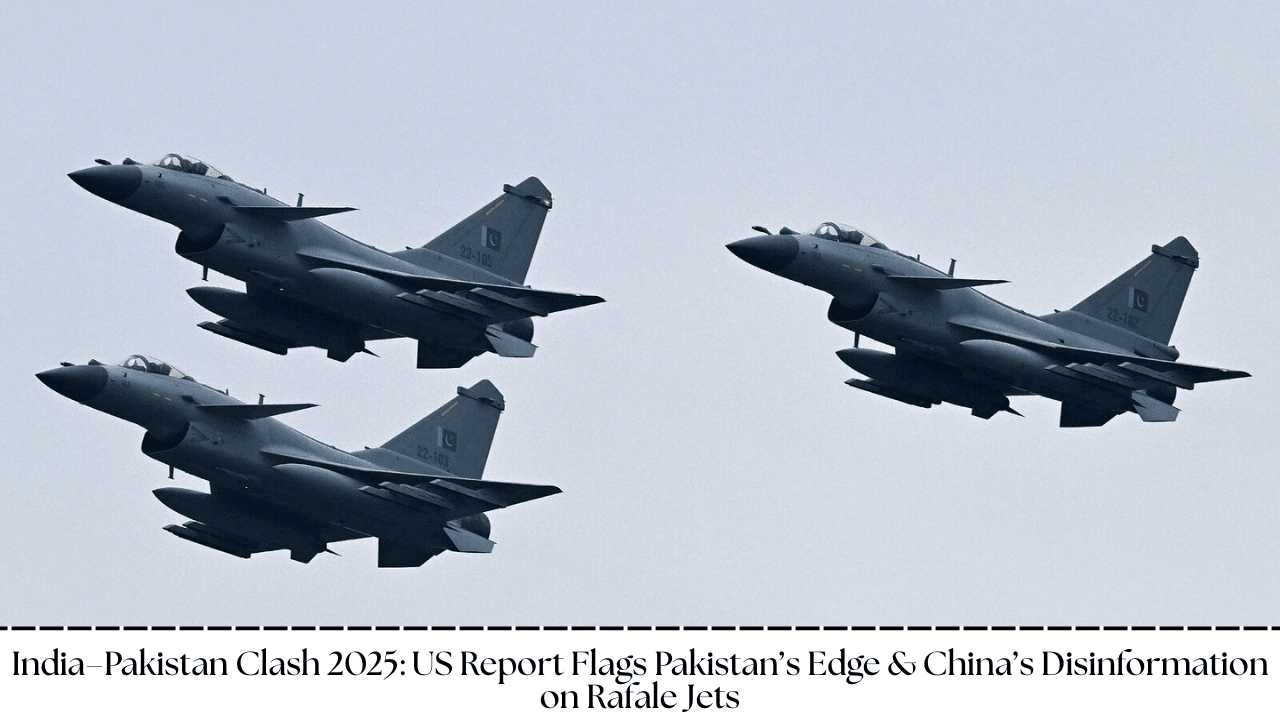
India–Pakistan Clash 2025: US Report Flags Pakistan’s Edge & China’s Disinformation on Rafale Jets
India–Pakistan Clash 2025: In May 2025, the confrontation between India and Pakistan — triggered by cross-border strikes and aerial engagements — has drawn renewed attention thanks to a recent annual report submitted by the U.S.–China Economic and Security Review Commission (USCC) to the U.S. Congress. The report contains two headline claims: first, that Pakistan achieved a notable military success in that encounter; second, that China ran a deliberate disinformation campaign to undermine the global image and sales of the French-made Dassault Rafale fighter jet.
Here is what the report asserts, why it matters, and what unanswered questions remain.
Key Claims from the Report
- According to the USCC, Pakistan’s air and missile forces made gains against India during the May skirmish, achieving at least a partial shift in operational advantage.
- The report alleges that China seized upon the conflict to bolster its own weapon systems’ narrative, deploying propaganda and disinformation techniques — in particular to harm the credibility of the Rafale jet and promote its own alternatives.
- As part of this disinformation strategy, the report notes China allegedly used fake social-media accounts, AI-generated imagery of wreckage or “shot-down” jets, and other narrative tools to suggest the Rafale had been successfully targeted by Chinese-backed Pakistani systems.
- The report warns that these tactics are not just about a single battle, but represent a broader campaign in the global arms trade: by weakening buyer confidence in Western systems like Rafale, China attempts to redirect procurement choices toward its own defence industry.
Why This Matters
- Strategic Messaging & Perception: Warfare today isn’t just kinetic. What one side claims publicly often influences international buyers, alliances and regional confidence. If Pakistan is seen to have achieved a “win”, that affects the deterrence balance in South Asia.
- Arms Export Dynamics: For France (and other Western defence exporters), the integrity of their platforms is as much about appearance as performance. Narrative-victory or –loss can influence future deals. By contrast, China appears to be leveraging narrative as part of its export playbook.
- Regional Defence Posture: India must contend not only with potential adversary capability but also with how these are presented and perceived. If China’s disinformation campaign succeeds, India’s choice of equipment and its image of aerial dominance may be challenged.
- Information Warfare as a Domain: The report underscores that disinformation, AI-driven imagery, social media operations are now theatre of war. Nations must build resilience in information security and truth management.
What Questions Remain
- Many of the “successes” claimed by Pakistan are still contested, with India not confirming some of the losses the other side alleges. Independent verification is limited.
- The exact scale of China’s disinformation campaign, its direct links to the Chinese state, and how much it shifted actual procurement decisions are not fully transparent.
- The full technical details — which jets exactly were lost or damaged, what systems were used — are still hidden behind both states’ operational security.
- Even if Pakistan gained tactical advantage, the report does not yet show whether that turned into a sustained strategic shift rather than a temporary edge.
Implications for the Future
- India may increase focus on building not just advanced platforms, but also the supporting ecosystem of electronic-warfare resilience, narrative control, and rapid debunking of false claims.
- Defence exporters and buyers globally may treat “information assurance” (how well a platform is portrayed, protected from narrative attacks) as part of the value-proposition, not just hardware specs.
- China’s role in South Asia defence markets may expand if it can demonstrate not just guns but the ability to shape perception — which is a potent soft-power lever.
- For Pakistan, the reputational angle matters: even if the actual physical damage was modest, being credited with a success (whether fully substantiated or not) helps morale, diplomacy and procurement leverage.
Conclusion
The USCC’s report brings into relief two evolving trends: first, the possibility that Pakistan managed to punch above its weight in the May 2025 India–Pakistan aerial/strike confrontation; second, the growing importance of narrative warfare as exemplified by China’s alleged disinformation campaign targeting the Rafale jet. While many facts are still shrouded, the broader lesson is clear: as wars evolve, the battles of perception and influence may become almost as consequential as missiles and fighters themselves.




Post Comment