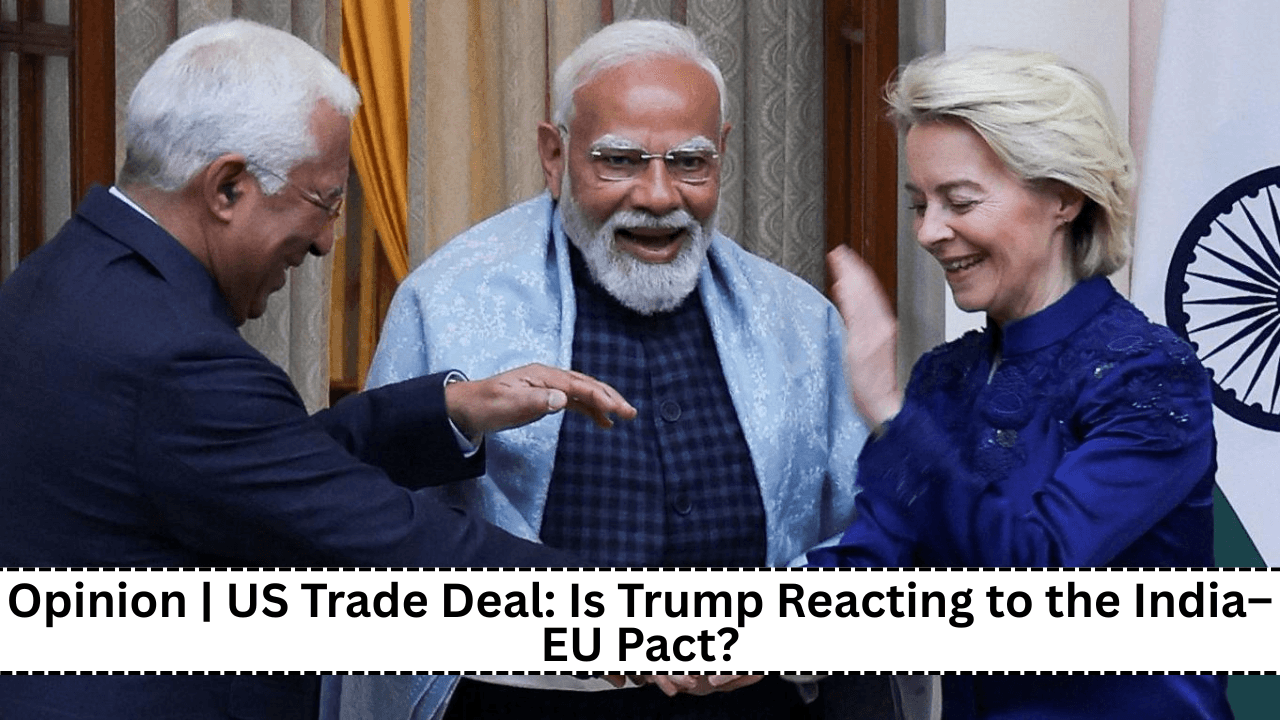
Opinion | US Trade Deal: Is Trump Reacting to the India–EU Pact?
The renewed push for a US trade deal has sparked debate among policy watchers. The timing feels anything but accidental. Coming soon after the India–EU pact, Washington’s urgency has prompted a provocative question: Is this Donald Trump’s version of FOMO—fear of missing out?
Trade, after all, is not just about tariffs and market access. It is also about who sets the rules first.
Why the India–EU Pact Matters
The India–EU agreement is more than a routine trade deal. It signals:
- Deepening economic alignment between two major markets
- Reduced dependence on traditional trade hubs
- A shared push for rules-based commerce
For the US, the pact reshapes the global trade map. It places India and the EU closer, while Washington risks being seen as reactive rather than proactive.
Trump’s Trade Style: Pressure Over Patience
During his political career, Donald Trump has preferred fast, headline-grabbing trade moves. He favors leverage, deadlines, and public pressure over slow diplomacy.
Seen through that lens, the sudden momentum on a US trade deal fits a familiar pattern:
- Act quickly to regain narrative control
- Signal strength to domestic audiences
- Prevent rivals from locking in long-term advantages
This is where the FOMO argument gains traction.

Is It Really FOMO—or Strategic Calculation?
Calling it FOMO may oversimplify the situation. The US still commands enormous economic power, and trade decisions rarely stem from emotion alone.
However, optics matter. When European Union and India move ahead without Washington, it challenges the US assumption of being the default economic partner.
In that sense, urgency may reflect a desire to reassert relevance, not panic.
What Washington Stands to Gain—or Lose
A successful US trade deal could:
- Secure market access before competitors do
- Protect American exporters
- Rebalance supply chains
But a rushed deal also carries risks:
- Weaker negotiating outcomes
- Short-term wins over long-term stability
- Perception of reaction rather than leadership
Trade partners notice not just terms—but timing.
The Bigger Picture: Global Trade Is Moving On
The real takeaway may be this: global trade no longer waits for Washington’s lead. Countries are increasingly comfortable forming blocs and bilateral agreements that bypass traditional power centers.
For the US, this is a strategic wake-up call. Influence now depends on engagement, not dominance.
Final Verdict
Is Trump’s renewed push for a US trade deal driven by FOMO after the India–EU pact? Partly—at least in perception. While strategic logic still guides US policy, the timing suggests concern about being left out of fast-forming trade networks.
In today’s multipolar economy, even the biggest players cannot afford to arrive late. Trade leadership, once assumed, now has to be earned—and maintained.



Post Comment