


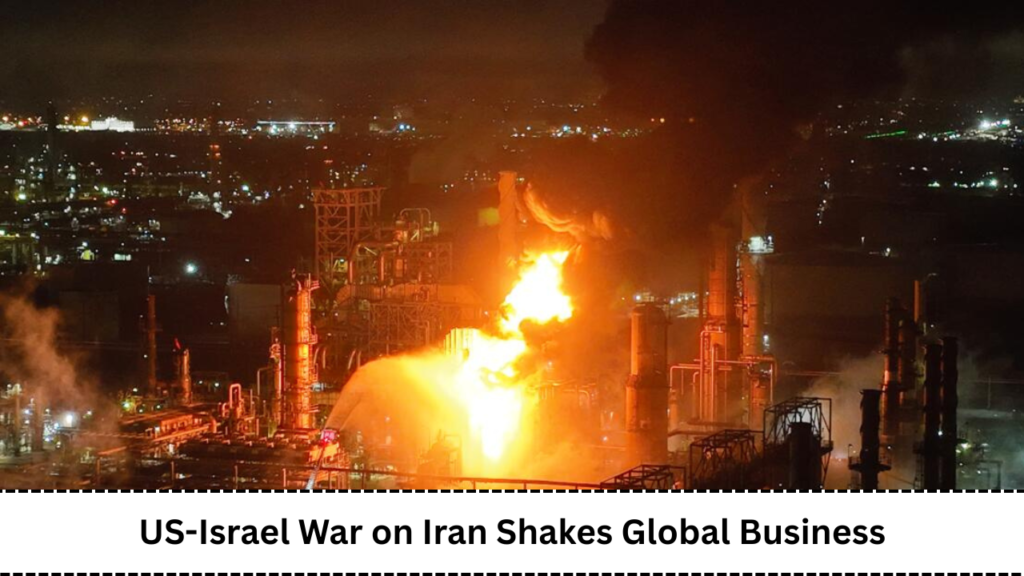
US-Israel War- The escalating conflict involving the United States, Israel, and Iran is beginning to reshape the global economic landscape. Beyond the battlefield, its effects are being felt across international trade, energy markets, and financial systems. Disruptions in oil supply, shipping corridors, and supply chains are forcing businesses and governments to rethink their economic plans and risk strategies.
Tensions intensified in February 2026 after the United States and Israel carried out coordinated strikes on Iranian targets. Iran responded with missile and drone attacks, pushing the Middle East into a period of heightened instability and raising global concerns about the wider consequences.


🌍 Energy Markets Under Pressure
Among all sectors, the energy market has experienced the most immediate impact. The conflict has created uncertainty around the Strait of Hormuz, one of the world’s most critical oil shipping routes, responsible for transporting roughly a fifth of global crude supply.
Because of the heightened risk in the region:
- Oil prices have climbed above $100 per barrel.
- Many oil tankers are avoiding the area, reducing maritime traffic.
- Several oil and gas facilities in the Gulf have faced disruptions or temporary shutdowns.
The surge in fuel costs is already affecting industries such as aviation, logistics, and manufacturing.
📉 Volatility in Financial Markets
Financial markets worldwide have reacted nervously to the growing tensions. Investors are increasingly worried about prolonged instability and its economic consequences.
Stock markets in several regions have shown sharp fluctuations as energy prices continue to rise. This situation has also sparked concerns about stagflation, a scenario where inflation increases while economic growth weakens.
Central banks are now in a difficult position as they balance the need to control inflation without slowing economic recovery.
🚢 Global Trade and Supply Chains Affected
The conflict has also created challenges for global trade. Shipping companies are becoming cautious about operating in the Persian Gulf due to safety concerns.
As a result:
- Cargo insurers have raised their premiums significantly.
- Some ports and logistics hubs have temporarily halted operations.
- Shipments of essential materials, including oil and industrial chemicals, have been delayed.
These disruptions are putting additional pressure on manufacturing industries that rely on timely delivery of raw materials.
💻 Risks for the Technology Sector
The technology industry could also face indirect consequences from the conflict. Certain resources essential for semiconductor manufacturing—such as helium and other industrial gases—are sourced from the Middle East.
If supply becomes unstable, chip production could slow down. This could impact global technology manufacturing and potentially delay the expansion of artificial intelligence infrastructure.
Higher energy costs are another challenge, as semiconductor production requires large amounts of electricity.
📊 Rising Inflation Concerns
Fuel and transportation expenses are increasing worldwide, which often leads to higher prices for everyday goods and services.
Economists warn that if the conflict continues:
- Inflation could accelerate globally.
- Economic growth may weaken.
- Some economies could face the risk of recession.
History shows that sudden spikes in energy prices often trigger wider economic slowdowns.
🏭 Businesses Navigating Uncertainty
Companies across different sectors are already adjusting their strategies to deal with the uncertainty.
Many businesses are:
- Postponing large investments
- Reviewing their supply chains
- Building extra inventory to reduce risk
- Looking for alternative energy and shipping routes
These changes reflect how geopolitical tensions can quickly reshape global business decisions.
📌 Final Thoughts
The US-Israeli conflict involving Iran has moved beyond regional tensions and is now influencing the global economy. From rising oil prices to supply chain disruptions, its effects are spreading across multiple industries.